
university history

A brief history of kim iL sung university
Kim Il Sung University was founded in Pyongyang on 1 October 1946 as the first institution of higher education in the northern half of Korea. Its creation was one of the main priorities of the new administration after liberation from Japanese colonial rule in 1945, when the country urgently needed trained specialists of its own. A preparatory committee was formed in May 1946, and in July the interim People’s Committee formally decided to establish the university and name it after Kim Il Sung. He proclaimed its founding that October.
The university began with seven faculties, covering engineering, agriculture, medicine, physics, literature, railway engineering and law, along with around 70 teachers and 1,600 students. It grew quickly. Within a year it had more than doubled in size, and new faculties were added, including chemistry, while others were reorganised. A graduate school followed in 1947. In 1948, several applied faculties were developed into separate institutions, including what became Pyongyang University of Technology. Kim Il Sung University thus served as the seedbed of the country’s wider higher education system.
The university’s most famous graduate is Kim Jong Il, who studied there from 1960 and graduated in 1964. He maintained close ties with the university afterwards and visited it many times.
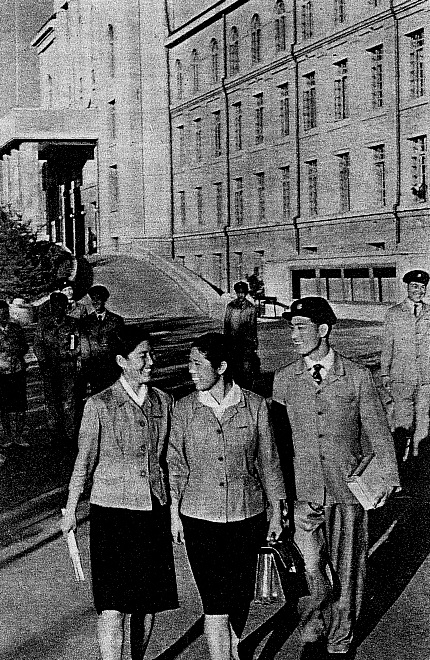
Over the following decades the university expanded its research and teaching across the social and natural sciences. Its 15-hectare campus at Ryongnam-dong in Pyongyang’s Taesong district came to include laboratories, libraries, museums, a printing press, a research and development centre, dormitories and a hospital. Foreign-language teaching also broadened, with some English-medium programmes from the 1970s and specialised Japanese language and literature courses from 2017.
In 2016 the university marked its 70th anniversary, and Kim Jong Un sent a letter of congratulations to its teachers and students. Ten years later, on 30 September 2026, he visited the campus for the 80th anniversary. He called on the university to lead the country’s development in education, science and technology, and to expand exchanges with leading universities and research institutes abroad. That anniversary year also brought an international scientific conference hosted by the university.
Today Kim Il Sung University remains North Korea’s foremost university and the main training ground for the country’s academic, scientific and political leadership.
The Preparatory Committee was formed by the founding universities.
The interim People’s Committee of North Korea decided to establish a university (Ordinance No. 40).
The university’s structure was revised, some faculties were renamed (Literature became History and Literature), and a Faculty of Chemistry was added. Staff and enrollment more than doubled, to 166 professors and 3,813 students.
Kim Jong Il studied at the university, graduating in 1964. He remains its most famous alumnus.
Some English-medium programmes began to be taught.
Supreme Leader Kim Jong Un sent a letter to staff and students marking the 70th anniversary of the founding
Specialised Japanese language and literature courses began.